

[:es]
OLIVER DESIGN REMODELA UN FERRY DE BANDERA TURCA PARA CONVERTIRLO EN CRUCERO DE LUJO ESPECIALMENTE DISEÑADO PARA RECORRER LA COSTA DE ESCOCIA
- Ha firmado un contrato con la compañía británica Magna Carta Steamship Ltd., para la que ya llevó a cabo un trabajo similar en el año 2000, cuando reconvirtió un transbordador griego en el lujoso “Lord of the Glens”
- Las modificaciones en el que pasará a llamarse “Lord of the Highlands” incluyen una ampliación de dimensiones en eslora y manga, la construcción de una cubierta adicional y una completa reforma de su interior para acomodar a 50 pasajeros y 17 tripulantes
- Los trabajos se llevarán a cabo en el puerto de Vigo (España), a donde el buque llegó el 21 de octubre, y la entrega está prevista para septiembrede 2019
- El trabajo de OLIVER DESIGN en este barco y en su predecesor ha permitido habilitar rutas turísticas únicas, de varios días de duración, entre el Mar del Norte y las Islas Hébridas a través del histórico Canal de Caledonia, construido a comienzos del siglo XI
Bilbao, 16 de OCTUBRE de 2018
OLIVER DESIGN, empresa española especializada en diseño y arquitectura naval, acaba de firmar un contrato con la británica Magna Carta Steamship Co Limited para remodelar un ferry de bandera turca y reconvertirlo en un crucero de lujo, especialmente diseñado para el turismo en la costa y los lagos de Escocia. La empresa española ya había desarrollado un proyecto similar para el mismo cliente en 2000, que ha habilitado una ruta turística única, conectando el Lago Ness con las islas Hébridas a través del histórico Canal de Caledonia.
El contrato, firmado en septiembre bajo la modalidad llave en mano, ha implicadoel traslado del ferry “Necdet Ali Yildirim” (que hasta la fecha conectaba el puerto turco de Cesme con la isla griega de Quíos) al puerto de Vigo, en el Norte de España, a dondellegó el 22 de octubre. En el plazo de un año, un ferry de pasaje con dos cubiertas que cubría un corto trayecto de apenas siete kilómetros se convertirá en una embarcación de lujo capaz de alojar 50 pasajeros en sus cuatro cubiertas y completar travesías de hasta una semana de duración.

La nave (de 42 metros de eslora por 9 de manga y 398 Toneladas de Registro Bruto-TRB) cambiará la bandera turca por la británica y pasará a llamarse “Lord of the Highlands”, y su nuevo destino exigirá una transformación radical en su diseño, incluyendo una ampliación de dimensiones en eslora y manga, la construcción de una cubierta adicional y una completa reforma de su interior para acomodar a 50 pasajeros y 17 tripulantes.

Tripulación del barco en ruta desde Turquia a Vigo
OLIVER DESIGN se ha responsabilizado, junto con la ingeniería Insenaval, de los aspectos técnicos del re-diseño, incluyendo los planos de la nueva estructura y la configuración de las soluciones en materia de estabilidad y seguridad. Además de las certificaciones necesarias de acuerdo a las regulaciones marítimas internacionales que exige la nueva configuración del barco, para su certificación por parte de Bureau Veritas y de la agencia británica MCA. La firma española se ocupará igualmente de dotar al “Lord of the Highlands” de las instalaciones eléctricas, tuberías, HVAC (climatización), tanques, medidas de prevención de incendios y demás servicios.

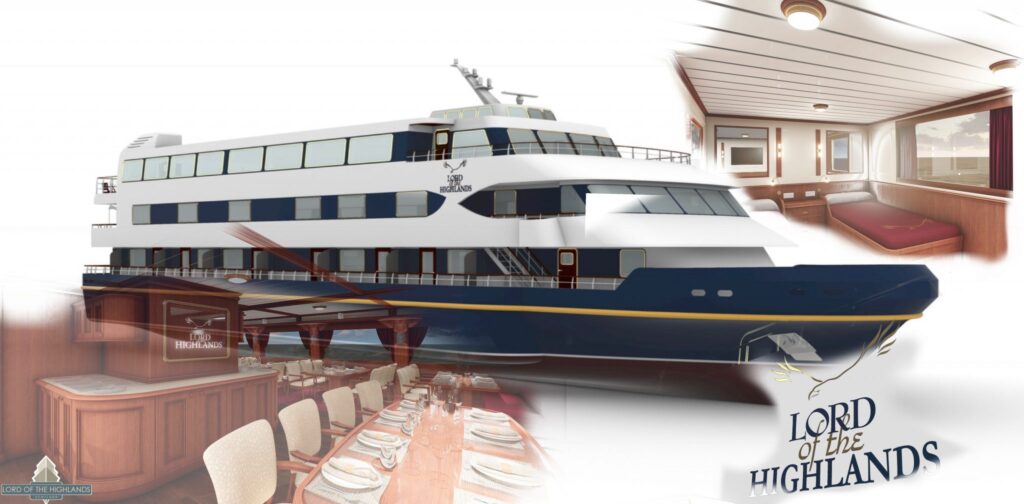
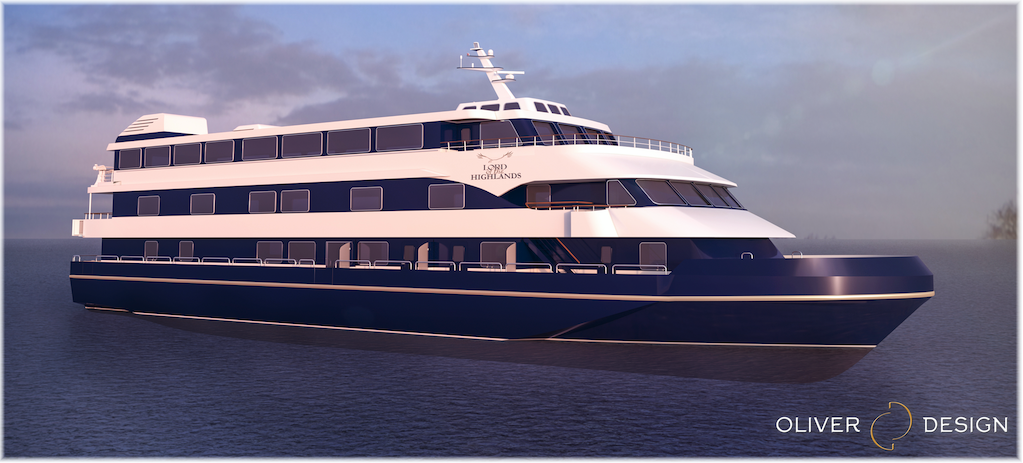
Nuevo Perfil exterior
Para llevar a cabo esta compleja tarea de reconversión del barco, OLIVER DESIGN liderará como project managersu planeamiento y ejecución, y contará con la colaboración de un selecto grupo de empresas especializadas en trabajos específicos relacionados con acero, aluminio, tuberías, electricidad o carpinterías. Parte de la obra se realizará a flote y, para los trabajos de varadero, se contará con la colaboración de Astilleros Armada, cuyas instalaciones se ubican en el mismo Puerto de Vigo.
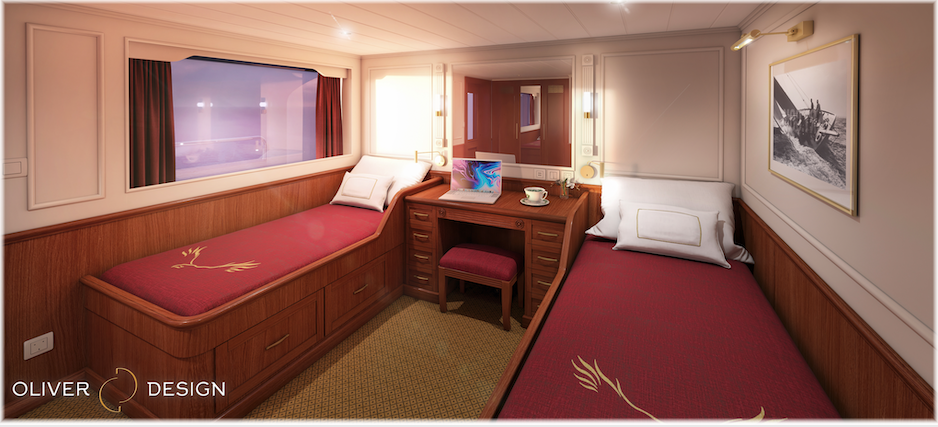
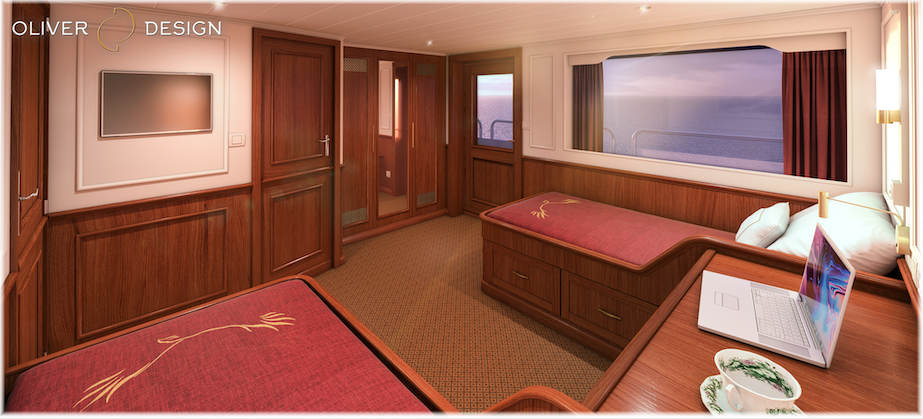
Recreación de los nuevos camarotes
La adaptación del barco a su nuevo uso implica una gran complejidad. Por un lado, por la necesidad de dotarlo de espacios y servicios de los que antes no disponía (restaurante, zona de bar y salón, camarotes para el pasaje y la tripulación, cocina, etc.). Por otro, porque el “Lord of the Highlands” requerirá una estabilidad adicional que se logrará ampliando la manga en un metro y dotándole de una nueva proa de acero que incrementará la eslora en dos metros y tendrá más altura sobre la línea de flotación.

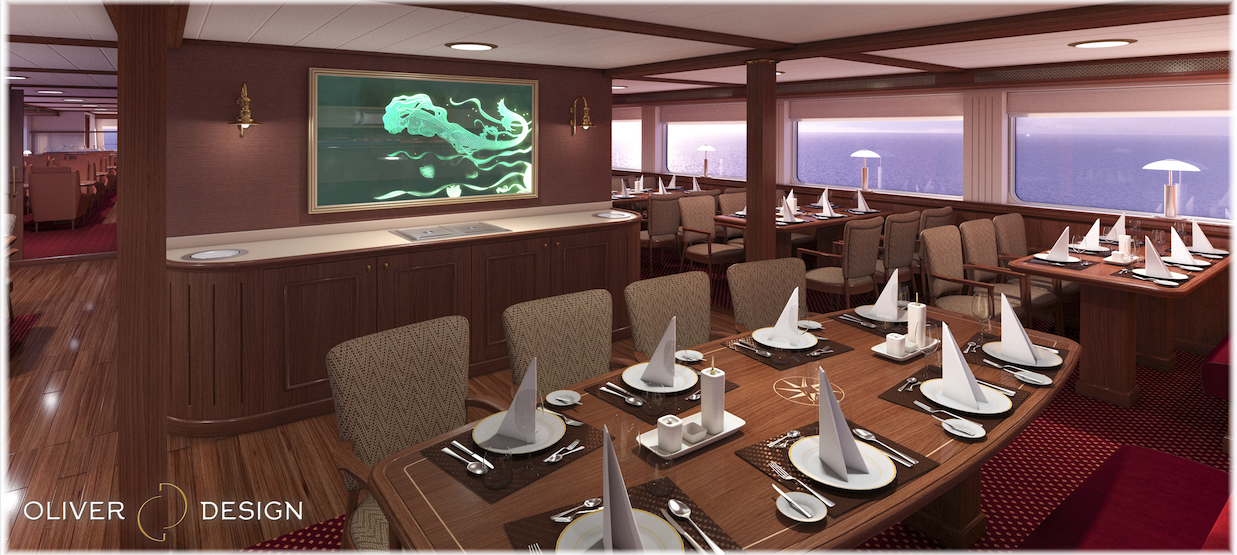
Recreación del restaurante.
Junto a los aspectos técnicos del diseño y a su habilitación en el astillero, OLIVER DESIGN se hará cargo de todo el diseño y la decoración interior, de acuerdo con los estándares de un crucero de lujo. Esto incluye distribuir nuevos camarotes y suites con balcones, además de cabinas para la tripulación, y dotar a todos los espacios de mobiliario, elementos decorativos, equipos de audio y video y otros complementos. En el exterior, el barco requerirá asimismo la instalación de nuevas barandillas, nuevas ventanas, claraboyas, escotillas, así como un mástil plegable sobre el puente de mando.

Recreación del Salon
Mas imágenes:
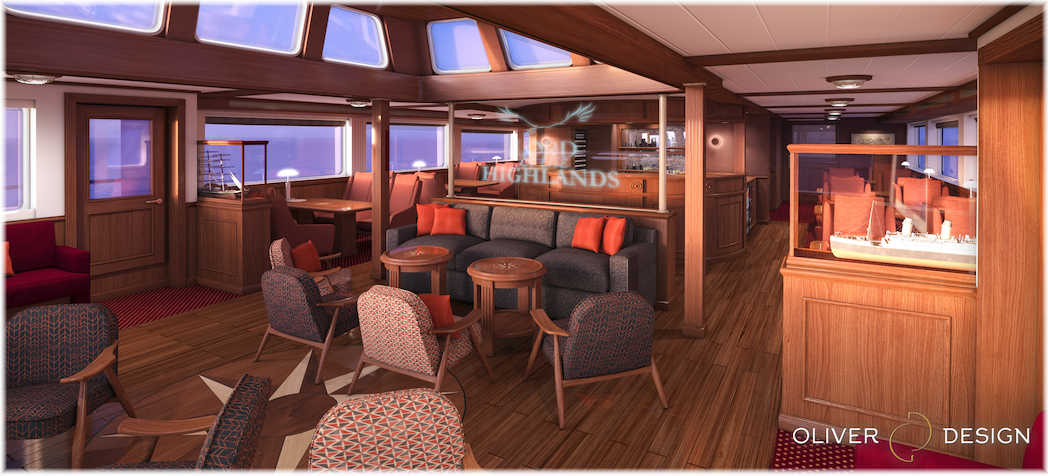
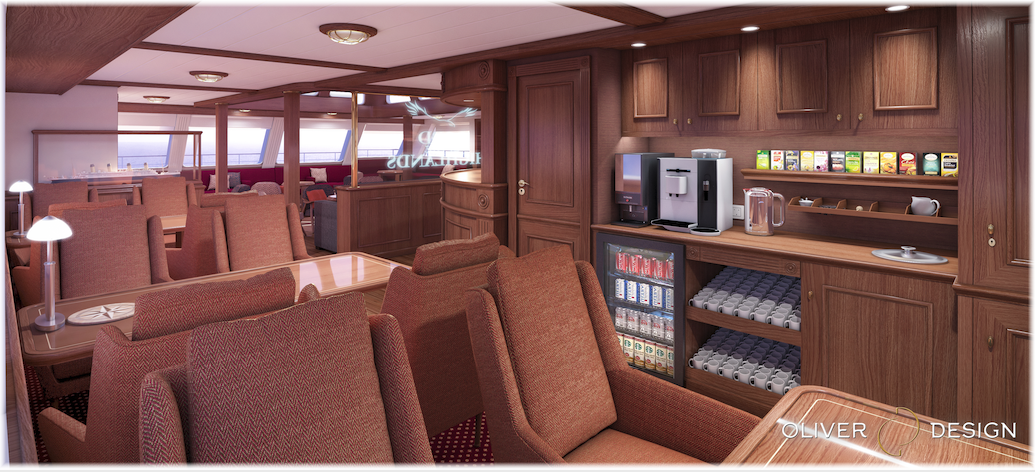
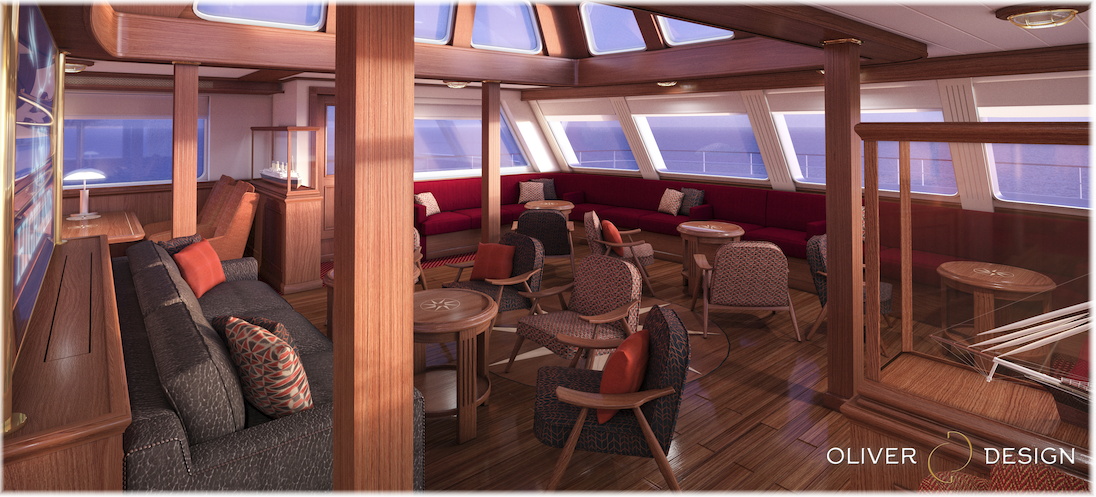
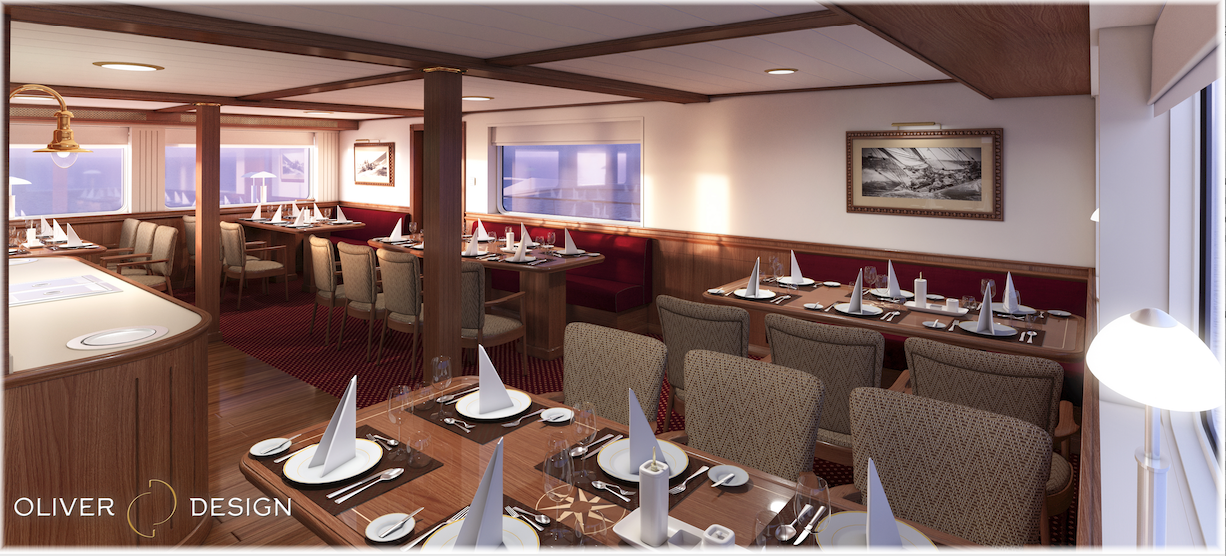
El antecedente del “Lord of the Glens”
Este contrato de OLIVER DESIGN con Magna Carta Steamship Ltd. Tiene un precedente en el trabajo que la firma española llevó a cabo con este mismo cliente en el año 2000.En aquel caso, se trató igualmente de remodelar un transbordador construido en 1985 que operaba en el Egeo en un crucero de pequeño formato destinado al turismo en Escocia. El “Lord of the Glens” tiene 46 metros de eslora por 10 de manga y 729 TRB, y dispone de cuatro cubiertas y una capacidad para 54 pasajeros y 20 tripulantes. Además de esta primera reconversión, OLIVER DESIGN se ocupó de su rehabilitación y puesta al día en 2015.
El “Lord of the Glens”, al igual que el “Lord of the Highlands” cuando entre en servicio, ha permitido a Magna Carta habilitar rutas turísticas únicas, de varios días de duración, entre el Mar del Norte y las Islas Hébridas, a través del famoso Lago Ness y del Canal de Caledonia, una obra de ingeniería singular que data de comienzos del siglo XIX, y una las costas Este y Oeste de Escocia aprovechando la falla geológica que atraviesa las tierras altas escocesas, y que incluye el famoso Lago Ness.
El Canal es uno de los grandes atractivos turísticos de las Highlandsescoceses, y conecta las localidades de Inverness y Fort William a lo largo de 97 kilómetros, de los cuales un tercio corresponden a una construcción iniciada en 1803 y culminada en 1822. Hasta 2004, las pequeñas dimensiones de las 29 esclusas que incluye el canal solo han permitido el paso de pequeñas embarcaciones de recreo.
Con la habilitación del “Lord of the Glens”, y la entrada en servicio de su barco hermano “Lord of the Highlands” a partir de 2019, Magna Carta es el primer operador turístico que pone en marcha un crucero a través de esta histórica ruta, la primera conexión marítima entre dos zonas de gran atractivo turístico como son, por un lado, LochNess y su conexión con el Mar del Norte, y por otro la costa Oeste Escocesa y las islas Hébridas (Mull, Iona, Skye, entre otras).
* Video(paso por las esclusas del “Lord of the Glens”)[:en]
OLIVER DESIGN REFASHIONS TURKISH-REGISTERED FERRY AS LUXURY CRUISE SHIP, TAILORED FOR THE CALEDONIAN CANAL AND SCOTTISH COAST
- The firm has signed a contract with the UK’s Magna Carta Steamship Company, for which it completed a similar project in 2000, converting a Greek ferry into the luxury “Lord of the Glens”.
- The refurbished vessel is to be rechristened “Lord of the Highlands”. Alterations include extending the vessel’s length and width, building an additional deck and completely reforming the interiors to house 50 passengers and a crew of 17.
- The alterations will be carried out in the port of Vigo (Spain), where the vessel arrived on 22 October. Delivery is scheduled for September2019
- Following Oliver Design’s work on the two ships, Magna Carta can now offer clients unique cruises lasting several days between the North Sea and the Hebrides, via the historic Caledonian Canal, built in the early nineteenth century
Bilbao, OCTOBER 16, 2018
Oliver Design, a Spanish firm specialising in naval design and architecture has signed a contract with the UK’s Magna Carta Steamship Company to carry out extensive alterations on a Turkish-registered ferry, fitting it out to operate as a luxury cruise ship, tailored to service the Scottish lochs and coasts. Oliver Design completed a similar project for the same client in 2000, allowing Magna Carta to offer a unique tourist cruise taking in Loch Ness and the Hebrides Islands via the historic Caledonian Canal.
Under the turnkey contract signed in September, the “Necdet Ali Yildirim” has now been transferred to the northern Spanish port of Vigo, where it arrived on 22 October. The two-deck ferry formerly plied a seven-kilometre route between the Turkish port of Çeşme and the Greek island of Chios. It is now to be converted into a luxury vessel capable of housing 50 passengers on four decks and embarking on week-long voyages.
The ship is to be rechristened the “Lord of the Highlands” and reregistered under a British flag. Currently 42 metres in width and 9 in the beam, it has a Gross Registered Tonnage of 398 tonnes. However, its new mission requires radical alterations to the design, including extensions to the length and beam, construction of an additional deck and complete refashioning of the interiors to house 50 passengers and a crew of 17.
SHIP CREW COMING FROM CESME (TURKEY) TO VIGO (SPAIN)
Alongside engineering firm Insenaval, Oliver Design has taken charge of the technical aspects of the re-design, including plans of the new structure and design of stability and safety solutions. It will also be responsible for obtaining certificates of compliance with international maritime regulations for the vessel’s new lay-out from Bureau Veritas and the British agency MCA. It will fit all the electrical installations, piping, heating, ventilation and air conditioning, tanks, fire prevention and other services.
New exterior profile
As the project manager, Oliver Design will head up planning and execution of the complex alterations, partnered by a select group of companies with specific specialities in the areas of steel, aluminium, pipes, electricity and carpentry. Some of the work will be performed afloat. All drydock work will be carried out under Oliver Design’s supervision at the Armada shipyards in Vigo.
View of the new Passenger Cabins
Adapting the ship to its new mission is a highly complex task. Entirely new areas and services will have to be fitted out, including a restaurant, bar and lounge area, cabins for passengers and crew, a galley, etc. At the same time, the “Lord of the Highlands” will require additional stability. This will be achieved by adding one metre to the beam, lengthening the ship by two metres by fitting a new steel bow and adding greater height above the waterline.
View of the new restaurant
As well as taking charge of the technical aspects of the design and outfitting in the shipyard, Oliver Design will also be responsible for creating interior design and decoration to the highest standards of a luxury cruise liner. This will include laying out new cabins and suites with balconiesand crew’s quarters, and providing the furnishings, decorative elements, audio and video equipment and other complements in all areas. In the exterior, new railings, windows, skylights, hatches, and a retractable mast on the bridge will all have to be fitted.
More images:
Previous experience with the “Lord of the Glens”
In 2000, Oliver Design worked with the Magna Carta Steamship Company on a similar contract, rebuilding a 1985 ferry then operating on the Aegean to operate as a small-format liner providing tourist cruises in Scotland. The “Lord of the Glens” is 46 metres in length by 10 in the beam and has a GRT of 729 tonnes. It has four decks and can accommodate 54 passengers and 20 crew. As well as this initial conversion work, Oliver Design also carried out rehabilitation and an upgrade in 2015.
Like the “Lord of the Highlands” when it comes into service, the “Lord of the Glens” has allowed Magna Carta to offer unique cruises lasting several days between the North Sea port of Inverness and the Hebrides, by way of the famous Loch Ness and the Caledonian Canal. The canal is an extraordinary feat of early nineteenth century engineering, linking Scotland’s east and west coasts through the Great Glen, a geological fault traversing the highlands which runs through the world-famous Loch Ness.
The 97-kilometre canal links Inverness and Fort William and is one of the great tourist attractions of the Scottish Highlands. One third of its length is man-made. Work on the canal began in 1803 and was completed in 1822. Until 2004, only small recreational craft were able to traverse the 29 small locks along the canal.
With the outfitting of the “Lord of the Glens”, to be followed in 2019 by its sister ship, the “Lord of the Highlands”, Magna Carta has become the first tourist operator to offer cruises along this historical route, the first maritime connection between two areas of great tourist appeal — Loch Ness and its North Sea outlet and the Scottish west coast and Hebrides (including Mull, Iona and Skye).
* Video “Lord of the Glens”[:]
Pingback: «Lord of the Highlands», un proyecto de Oliver Design, en el último número de la revista «Ship & Boat International»